The Global Oil Market: Far More Complex Than Just Brent and WTI Prices
The IOM 2006 crude oil database hosted on Cloudflare Edge is revealing a fascinating and complex picture of the global energy landscape. Beyond the widely publicized Brent and West Texas Intermediate (WTI) benchmarks, the real world of crude oil consists of hundreds of distinct types, each with unique characteristics that directly impact pricing, refining economics, and national import strategies.
Unveiling the Complexity: 167 Types of Crude Oil
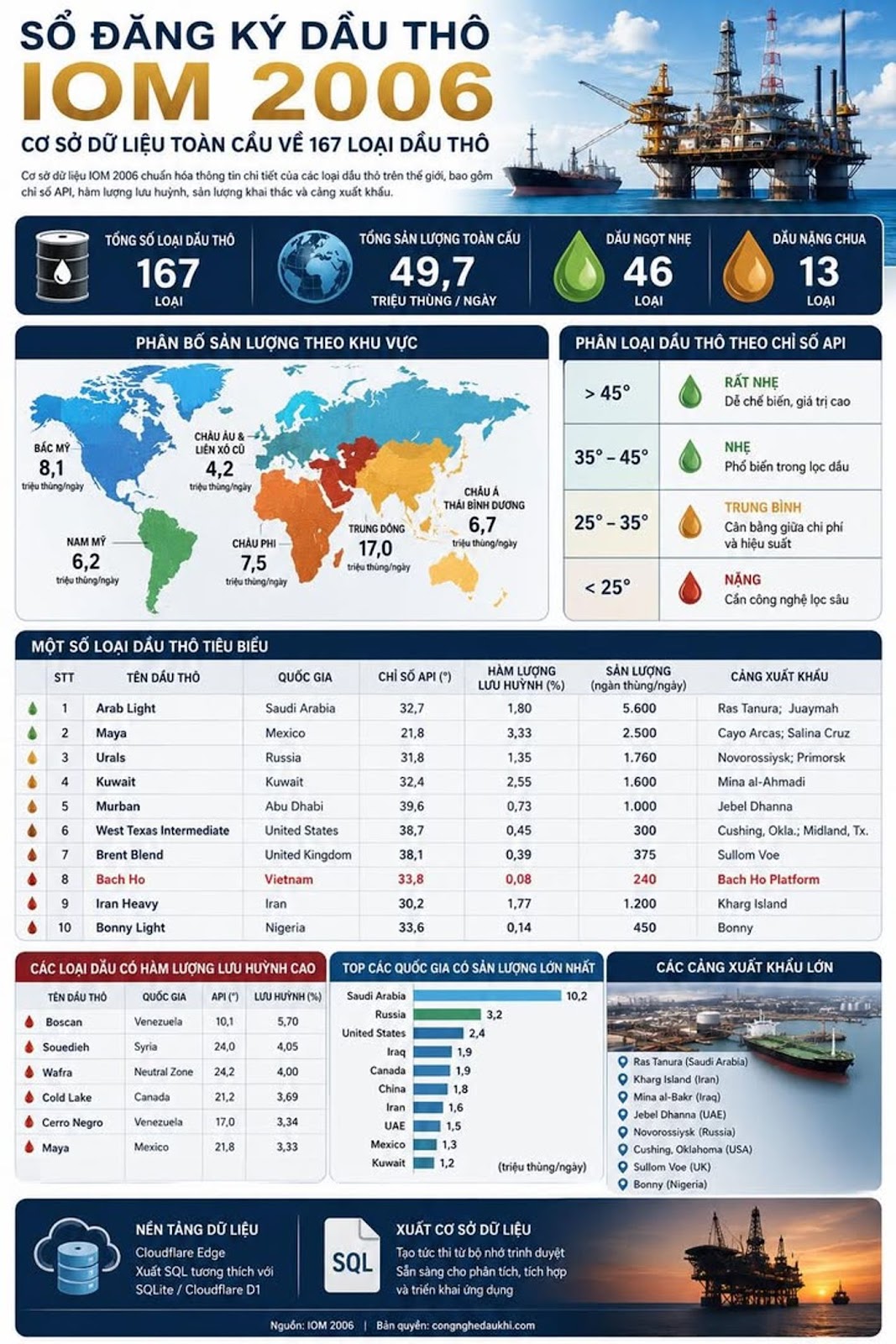
According to the IOM 2006 database, the global oil market comprises 167 distinct types of crude oil, with a total global production of approximately 49.7 million barrels per day. These crude oils are categorized primarily by quality, with 46 types classified as light sweet crude and 13 types as heavy sour crude. This diversity highlights that oil quality is not merely a technical specification but a critical factor that directly influences commercial value, refining margins, and strategic import decisions for nations worldwide.
Key Database Statistics
| Indicator | Data |
|---|---|
| Total crude oil types | 167 |
| Total recorded production | 49.7 million barrels per day |
| Light sweet crude group | 46 types |
| Heavy sour crude group | 13 types |
| Reference basis | IOM 2006 |
| Platform deployment | Cloudflare Edge |
The Quality Divide: Light Sweet vs. Heavy Sour Crudes
Most striking is the significant variation between different crude types. For instance, West Texas Intermediate from the United States has an API gravity of 38.7° and sulfur content of 0.45%, placing it in the relatively light category that is easier to refine. In contrast, Mexico's Maya crude has an API gravity of just 21.8° and sulfur content of 3.33%, making it substantially heavier and more sour. These quality differences mean that even though both are classified as crude oil, their commercial values can vary dramatically.
Notable Crude Oils in the Global Market
| Crude Oil Name | Country | API Gravity | Sulfur Content | Production |
|---|---|---|---|---|
| Arab Light | Saudi Arabia | 32.7° | 1.80% | 5.6 million barrels per day |
| Maya | Mexico | 21.8° | 3.33% | 2.5 million barrels per day |
| Urals | Russia | 31.8° | 1.35% | 1.76 million barrels per day |
| Kuwait | Kuwait | 32.4° | 2.55% | 1.6 million barrels per day |
| Murban | Abu Dhabi | 39.6° | 0.73% | 1 million barrels per day |
| West Texas Intermediate | United States | 38.7° | 0.45% | 300 thousand barrels per day |
| Bach Ho | Vietnam | 33.8° | 0.08% | 240 thousand barrels per day |
Comparing Benchmark Crudes: More Than Meets the Eye
The comparison between different benchmark crudes reveals why market participants must look beyond daily price reports. While WTI and Brent often dominate headlines, other crudes like Murban and Vietnam's Bach Ho offer distinct characteristics that affect their market value and processing requirements.
| Criteria | West Texas Intermediate | Brent Blend | Murban | Bach Ho |
|---|---|---|---|---|
| Country | United States | United Kingdom | Abu Dhabi | Vietnam |
| API Gravity | 38.7° | 38.1° | 39.6° | 33.8° |
| Sulfur Content | 0.45% | 0.39% | 0.73% | 0.08% |
| Production | 300 thousand barrels per day | 375 thousand barrels per day | 1 million barrels per day | 240 thousand barrels per day |
| Characteristics | Standard American light crude | European benchmark reference | Notable Middle East light crude | Vietnamese crude with very low sulfur |
The Heavy Sour Segment: Specialized but Significant
Heavy sour crude oils represent a specialized segment of the market that requires sophisticated refining capabilities but plays a crucial role in the global energy supply chain. These crudes typically command lower prices due to their higher sulfur content and density, but can be economically attractive when discounted sufficiently.
The heavy sour category includes notable varieties such as Venezuela's Boscan, with extremely high sulfur content of 5.70%, and Canada's Cold Lake at 3.69% sulfur. These crudes are not suitable for all refineries but are essential for facilities equipped with advanced hydrotreating and coking units designed to handle challenging feedstocks.
High-Sulfur Crude Oils of Note
| Crude Oil Name | Country | API Gravity | Sulfur Content |
|---|---|---|---|
| Boscan | Venezuela | 10.1° | 5.70% |
| Souedieh | Syria | 24.0° | 4.05% |
| Wafra | Neutral Zone | 24.2° | 4.00% |
| Cold Lake | Canada | 21.2° | 3.69% |
| Cerro Negro | Venezuela | 17.0° | 3.34% |
| Maya | Mexico | 21.8° | 3.33% |
Geopolitical Implications: Why Location Matters
The IOM 2006 database helps explain why geopolitical events in different regions impact oil prices in varying ways. The market doesn't simply experience shortages or surpluses of "oil" in general; it faces imbalances of specific crude types that particular refineries require. When disruptions occur in major producing regions like the Middle East, Russia, Venezuela, Nigeria, or the North Sea, the impact depends on which specific crude types are affected and which refineries rely on them.
Saudi Arabia's dominance is clearly illustrated by Arab Light's production of 5.6 million barrels per day, making it a critical market anchor. Meanwhile, Mexico's Maya represents a significant heavy sour stream that serves specialized refineries worldwide.
Regional Highlights: Vietnam's Bach Ho
Among the global tapestry of crude oils, Vietnam's Bach Ho stands out for its exceptional quality characteristics. With an API gravity of 33.8° and sulfur content of just 0.08%, Bach Ho offers a compelling value proposition in an era of increasingly stringent environmental regulations. The ultra-low sulfur content makes it particularly attractive to refineries seeking to produce cleaner fuels with lower processing requirements.
Bach Ho's characteristics position Vietnam as a significant player in the high-quality crude segment, despite its relatively modest production volume of 240 thousand barrels per day. This highlights how quality can be as important as quantity in the global oil market.
Technical Advantages of the IOM 2006 Database
Beyond its value as a reference tool, the IOM 2006 database offers technical advantages that enhance its utility for industry professionals. The system supports SQL export capabilities, making it compatible with SQLite or Cloudflare D1. This transforms traditional energy reference data into a searchable, categorizable, and analyzable database that can be directly deployed on web platforms.
For the oil and gas industry, this capability provides a foundation for developing sophisticated market analysis tools, energy education platforms, and industry-specific dashboards. It enables researchers, traders, and policymakers to move beyond simple price indicators and understand the fundamental dynamics of crude oil quality and distribution.
Conclusion: Understanding the Nuances of Global Oil Markets
The 167 types of crude oil documented in the IOM 2006 database reveal that the global oil market is far more complex than daily Brent or WTI price indicators suggest. Each barrel of oil carries with it a story of geology, refining technology, logistics, export infrastructure, sulfur content, and global energy dynamics.
In an increasingly interconnected energy landscape, the ability to understand and analyze crude oil quality differentials provides a significant competitive advantage. Market participants who can identify and capitalize on these subtle variations will be better positioned to navigate price volatility, optimize refinery operations, and make informed strategic decisions.
As the energy transition unfolds and environmental regulations continue to tighten, the distinctions between crude oil types will likely become even more pronounced. The IOM 2006 database offers a valuable window into this complex reality, helping stakeholders decode the intricate language of global oil markets.