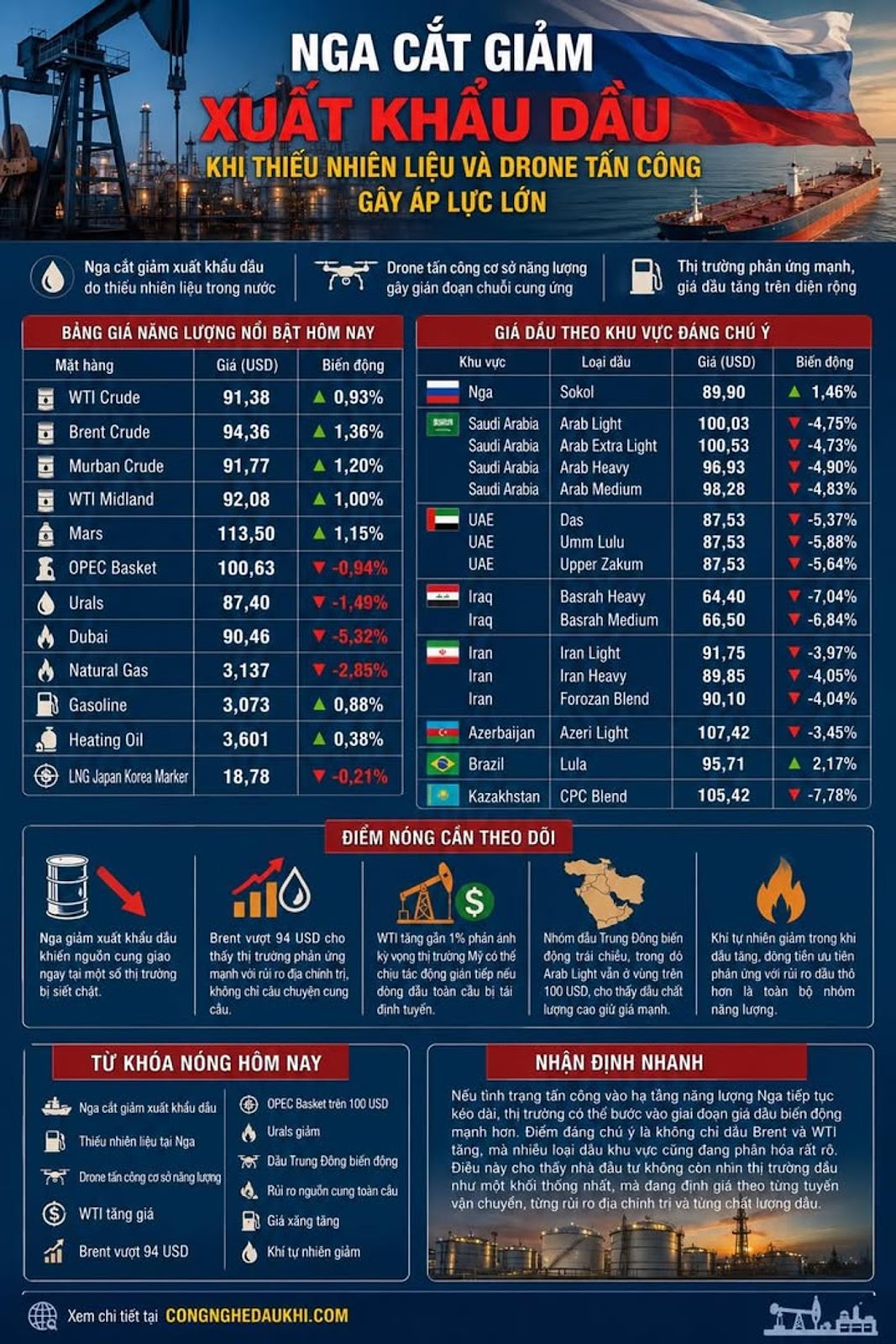
Russia Cuts Oil Exports Amid Domestic Fuel Shortages and Drone Attacks, Creating Significant Supply Pressure
The global energy market is facing potential new supply shocks as Russia reduces its oil exports due to a combination of domestic fuel shortages and ongoing drone attacks on energy infrastructure. This development has immediately impacted crude benchmarks, with WTI rising to $91.38, Brent climbing to $94.36, and Murban reaching $91.77 per barrel.
Market Response to Russian Export Reductions
The energy market has reacted strongly to news of Russia's export cuts, which stem from multiple converging factors. Domestically, Russia is experiencing fuel shortages that have forced authorities to prioritize domestic supply over exports. Simultaneously, persistent drone attacks on Russian energy infrastructure have disrupted refining operations and transportation networks, further constraining available supply for international markets.
"This represents a significant shift in the global oil supply landscape," noted energy analyst Elena Petrova. "When a major producer like Russia faces both domestic constraints and external threats, the ripple effects are felt across the entire market."
Energy Price Movements
The impact of these developments is clearly visible in today's energy price movements, with most crude benchmarks experiencing gains while some refined products and regional benchmarks show mixed results.
| Commodity | Price | Change |
|---|---|---|
| WTI Crude | $91.38 | +0.93% |
| Brent Crude | $94.36 | +1.36% |
| Murban Crude | $91.77 | +1.20% |
| WTI Midland | $92.08 | +1.00% |
| Mars | $113.50 | +1.15% |
| OPEC Basket | $100.63 | -0.94% |
| Urals | $87.40 | -1.49% |
| Dubai | $90.46 | -5.32% |
| Natural Gas | $3.137 | -2.85% |
| Gasoline | $3.073 | +0.88% |
| Heating Oil | $3.601 | +0.38% |
| LNG Japan Korea Marker | $18.78 | -0.21% |
Regional Price Variations
The price impact varies significantly across different regional benchmarks, reflecting localized supply concerns and market dynamics:
| Region | Oil Type | Price | Change |
|---|---|---|---|
| Russia | Sokol | $89.90 | +1.46% |
| Saudi Arabia | Arab Light | $100.03 | -4.75% |
| Saudi Arabia | Arab Extra Light | $100.53 | -4.73% |
| Saudi Arabia | Arab Heavy | $96.93 | -4.90% |
| Saudi Arabia | Arab Medium | $98.28 | -4.83% |
| UAE | Das | $87.53 | -5.37% |
| UAE | Umm Lulu | $87.53 | -5.88% |
| UAE | Upper Zakum | $87.53 | -5.64% |
| Iraq | Basrah Heavy | $64.40 | -7.04% |
| Iraq | Basrah Medium | $66.50 | -6.84% |
| Iran | Iran Light | $91.75 | -3.97% |
| Iran | Iran Heavy | $89.85 | -4.05% |
| Iran | Forozan Blend | $90.10 | -4.04% |
| Azerbaijan | Azeri Light | $107.42 | -3.45% |
| Brazil | Lula | $95.71 | +2.17% |
| Kazakhstan | CPC Blend | $105.42 | -7.78% |
Key Market Points to Monitor
Several critical developments are emerging that market participants should closely watch:
- Tightened Spot Supply: Russia's export reductions could lead to immediate supply constraints in certain markets, particularly as demand remains elevated during the peak driving season.
- Geopolitical Risk Premium: Brent's climb above $94 indicates the market is responding strongly to geopolitical risks beyond typical supply-demand fundamentals.
- Indirect U.S. Impact: WTI's near 1% increase suggests expectations that the U.S. market could be indirectly affected if global oil flows are rerouted.
- High-Quality Oil Premium: The mixed performance of Middle Eastern oils, with Arab Light remaining above $100, shows that premium quality crude continues to command strong prices.
- Market Divergence: Natural gas prices are declining while crude oil rises, indicating that market capital is prioritizing responses to crude oil risks rather than across the entire energy complex.
Market Analysis
If drone attacks on Russian energy infrastructure continue, the market could enter a period of heightened price volatility. Notably, it's not just Brent and WTI that are rising—many regional crude benchmarks are showing clear differentiation. This suggests that investors are no longer viewing the oil market as a monolithic entity but are instead pricing based on specific shipping routes, geopolitical risks, and crude quality differentials.
"The market is becoming increasingly fragmented," explains energy trader Marcus Johnson. "We're seeing decoupling between benchmarks as each grade's price is being determined by its own supply chain vulnerabilities and transportation risks."
Future Implications
The situation in Russia highlights the growing vulnerability of global energy supplies to both domestic policy shifts and asymmetric warfare tactics. As drone technology becomes more accessible and sophisticated, energy infrastructure faces unprecedented security challenges that could have cascading effects on global markets.
For consumers, this development could translate to higher transportation costs and potentially increased prices at the gasoline pump, particularly in regions heavily dependent on Russian oil imports. For policymakers, the situation underscores the importance of diversifying energy sources and strengthening supply chain resilience.
As the situation evolves, market participants will be closely monitoring Russia's export policies, the effectiveness of its domestic fuel allocation measures, and the trajectory of drone attacks on its energy infrastructure. These factors will collectively determine whether the current price pressures prove temporary or signal a more sustained period of market turbulence.


